- Approval reversed
- A built 500 kV line halted after the towers were standing — proof the fight outlasts the permit
- 3.5 of ~179 mi
- Only that stretch was buried — Chino and Ontario kept the overhead 500 kV towers
- +$224M
- Extra cost for burial, billed to ratepayers — for the same line, just relocated
What the citizens actually won
The Tehachapi Renewable Transmission Project is Southern California Edison's 500 kV line carrying wind power from Kern County to the Los Angeles Basin. In December 2009, the CPUC approved its route through Chino Hills — Segment 8A — calling it the “environmentally superior route.” By 2011, SCE was erecting nearly 200-foot steel towers in a 150-foot right-of-way directly over a residential neighborhood. [1] [2]
The City of Chino Hills and a grassroots residents' group, Hope for the Hills, refused to accept it. They organized their neighbors, packed CPUC hearings, went to court, and petitioned to reopen the approval — and won an order halting construction while the Commission reconsidered. On July 11, 2013, the CPUC voted 3–2 to tear down the 16 towers and poles SCE had already put up (Decision D.13-07-018). A small city spent about $2.4 million and years of effort and beat one of the largest utilities in the country — after the steel was already in the ground. That is the transferable victory, and it should give every one of us courage: ordinary residents who would not quit reopened an approval and stopped construction. [3] [1] [2]
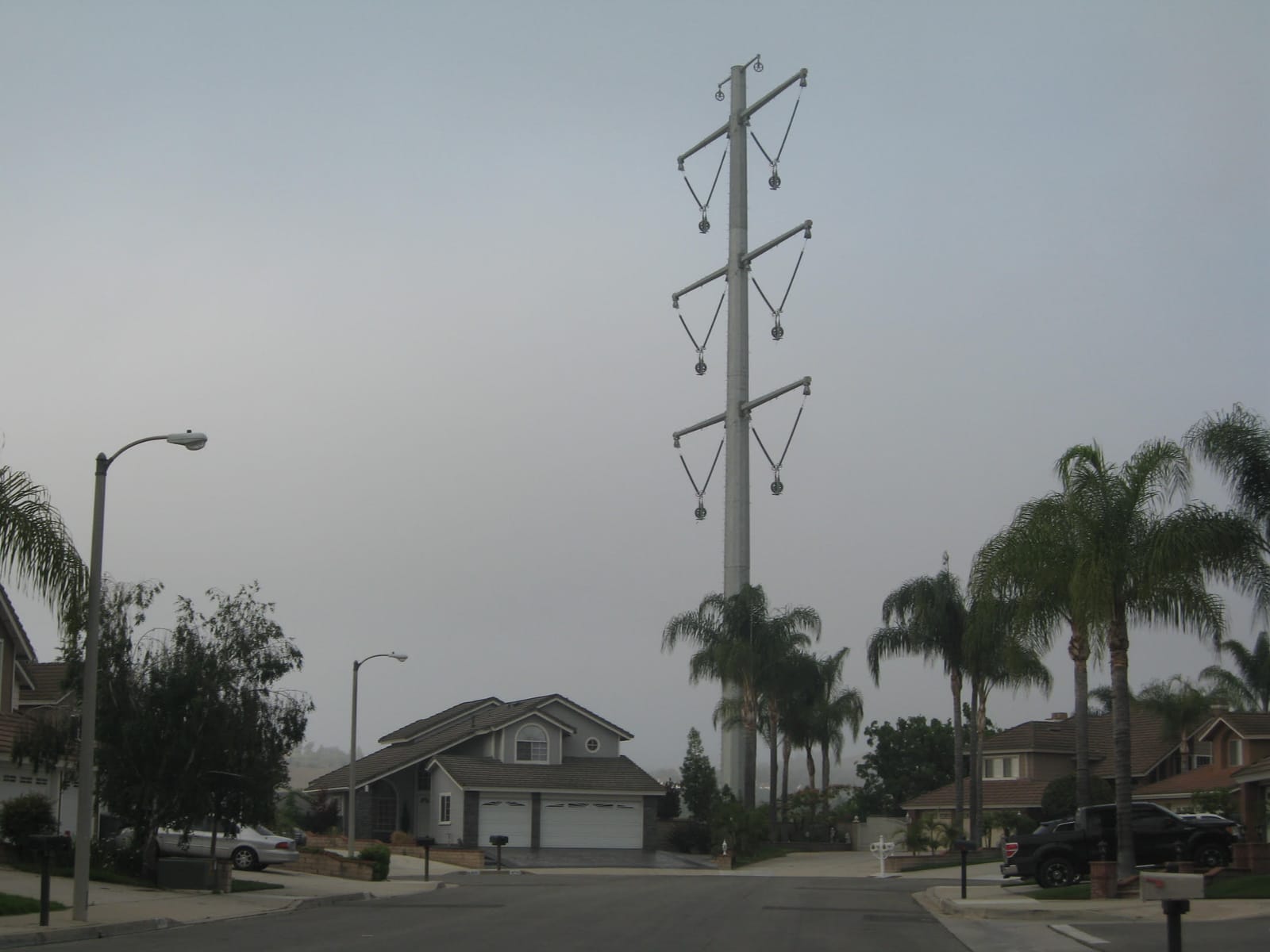
A 500 kV pole in the Segment 8A right-of-way, looming over a Chino Hills cul-de-sac.
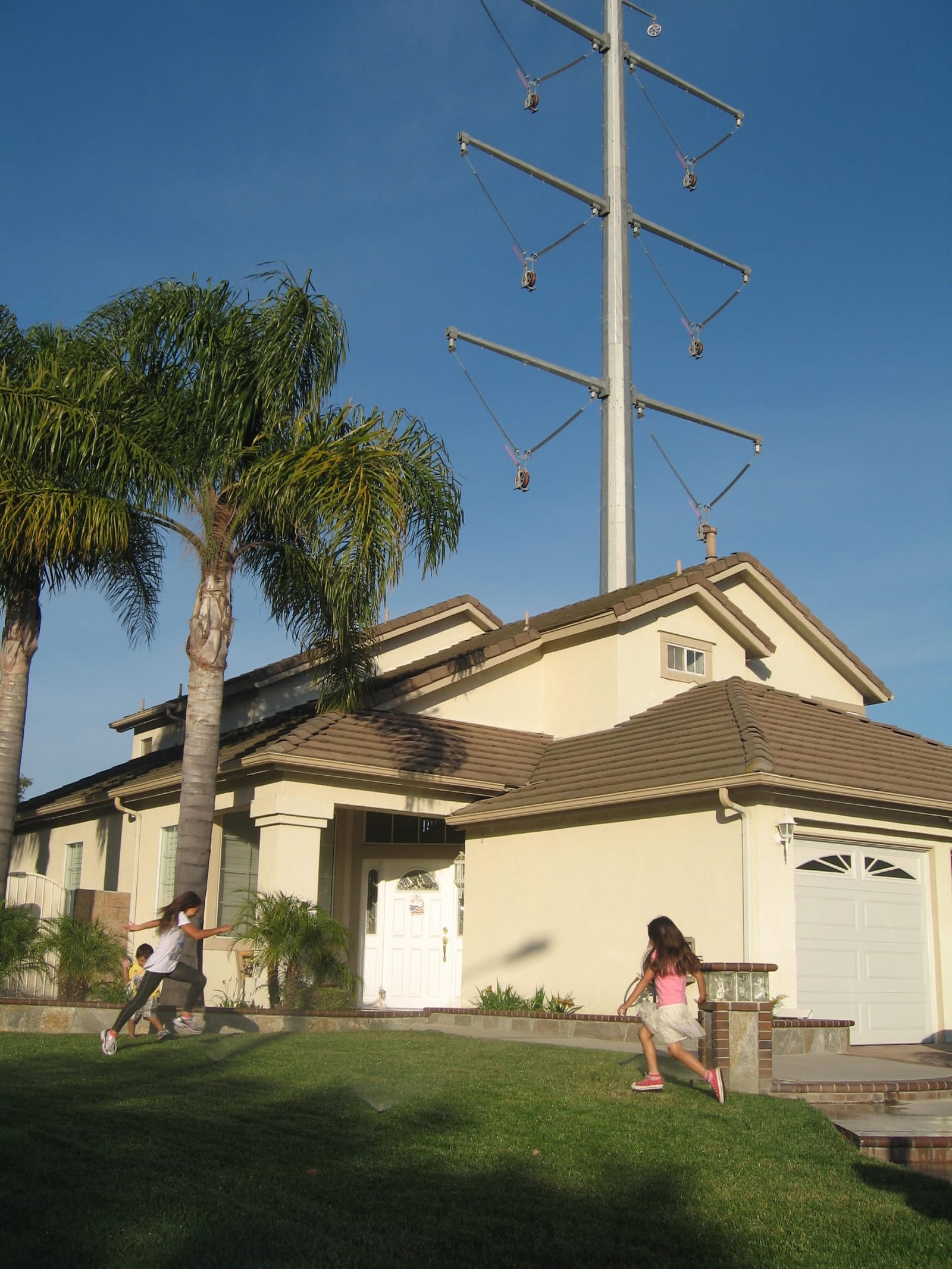
The towers stood directly over homes and yards — here, just behind a family's front lawn.
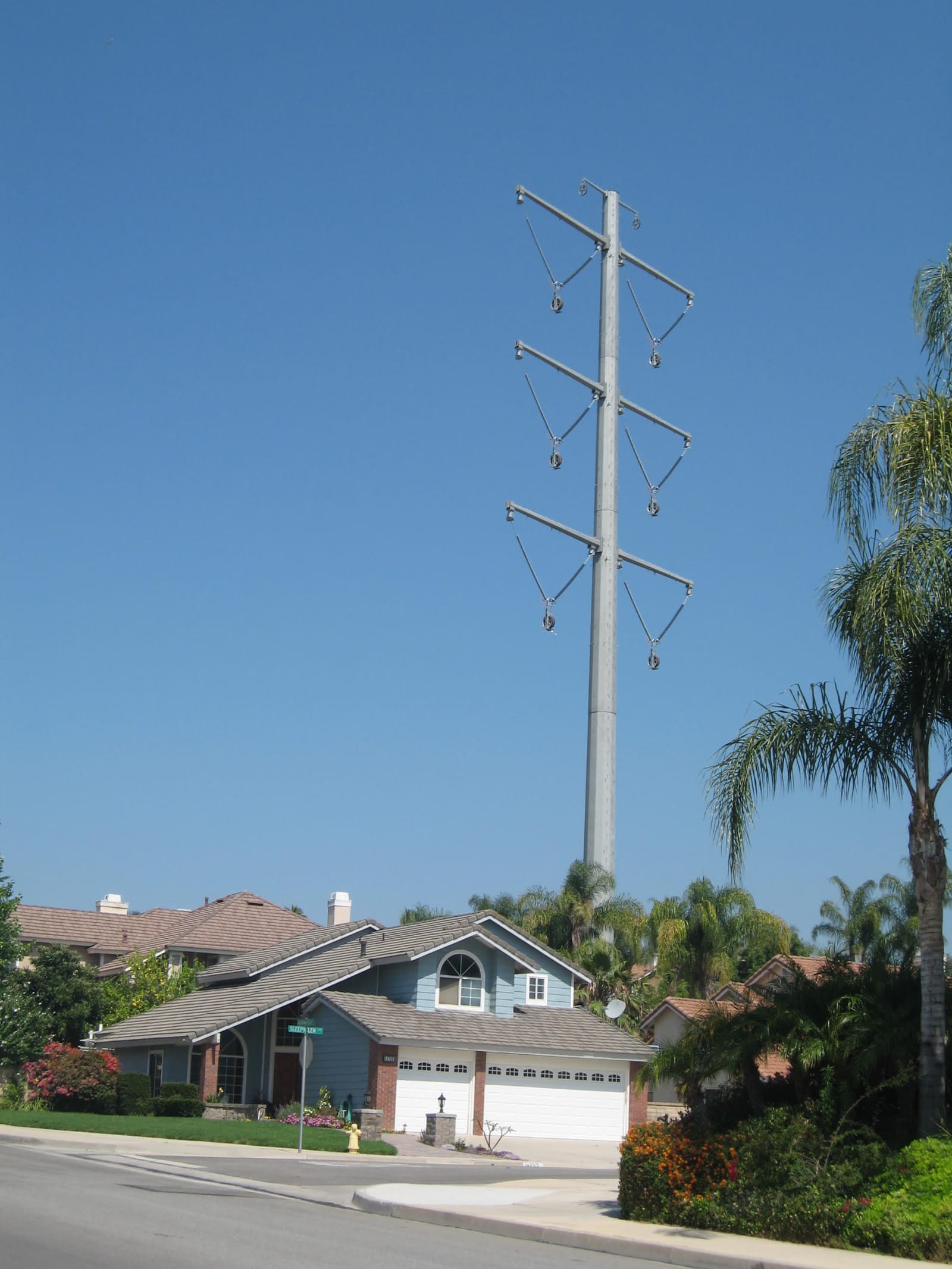
Nearly 200 feet of steel beside a two-story house — the kind of structure the CPUC ordered torn down.
What SCE did next — not what Chino Hills wanted
Here the credit belongs to the residents and the blame to the utility. Hope for the Hills fought to get the line out of their community, and won. What the CPUC and SCE then handed them was not removal but relocation: 3.5 miles put underground, while the rest of the ~179-mile project stayed up on 200-foot lattice towers. The same month the buried segment energized, SCE switched on overhead 500 kV lines through neighboring Chino and Ontario. That was SCE's choice, not the activists' — they were never offered a clean “no line” option, only the system's narrow menu of where the towers would go. Undergrounding one community's stretch didn't delete the towers; the utility simply moved them to the neighbors. [5]
And the buried stretch is not invisible either. To take a 500 kV line underground and back, SCE built two ~three-acre above-ground “transition stations,” one at each end, where the cables surface at 17-foot oil-filled terminations and the lattice towers resume. A buried line still has an industrial footprint — it just relocates it. [4]
Burying a 500 kV line is its own kind of destruction
Undergrounding trades the tower for a massive civil project. In Chino Hills the cables ran in concrete duct banks in trenches 7.5 feet deep and 7.5 feet wide, fed by 42 concrete splice vaults each 64 feet long plus dozens of smaller ones, and the route had to be drilled as deep as 150 feet beneath two flood-control channels to get under the water. This is not a gentle alternative — it is years of trenching, drilling, and concrete. [4]
In Temecula that trench would run the Temecula Creek corridor — an active streambed and groundwater-recharge channel where tower footings already reach below the water table. Burying the line there means excavating and dewatering through a living creek and its floodplain — the same federally protected waters a §404/§401/§1602 permit gauntlet exists to guard. [4] [7]
And it gets worse if an aqueduct is in the way. We haven't confirmed the alignment crosses one of the region's water-conveyance aqueducts — but if it did, a 500 kV cable can't simply be trenched across it. The line would have to be drilled deep beneath the channel, exactly as Edison had to bore 150 feet under Chino Hills' flood-control channels, and the constant heat a buried 500 kV cable sheds would sit against infrastructure carrying drinking water for whole communities downstream. A failure or future fault next to a major aqueduct isn't a local inconvenience — it's a regional water-supply risk, and the water agency that owns the aqueduct would have its own say over whether the crossing is allowed at all. [4]
Why it matters for Temecula
Take the lesson, and honor the people who taught it. Chino Hills proves a determined community can reopen an approved 500 kV project and stop construction even after the towers go up — Hope for the Hills wrote the playbook we get to use, and we should be grateful for it. Keep that tool in reserve. [3] [1]
And here is the heartening part: we start ahead of where Chino Hills did. Our goal is no line through here at all, above or below ground — and unlike Chino Hills, we are in this fight before the towers go up, with the chance to demand the outright “no project” option rather than choose between bad placements. Undergrounding is not a compromise to accept: it would still cut the same corridor, still need above-ground transition yards, still leave towers standing for our neighbors, and on top of that tear open Temecula Creek and add hundreds of millions to ratepayers' bills. The answer to a destructive line is not a costlier, equally destructive version of it — it's the “no project” option and a route that doesn't come through Riverside County. [4] [5] [6]
Sources
- [1]City of Chino Hills TRTP & Undergrounding pages; Hope for the Hills — City of Chino Hills / Hope for the Hills (Wikipedia)
- [2]SCE puts 500-kV underground at Chino Hills — trade & news coverage — T&D World / TransmissionHub / Edison International
- [3]CPUC Decision D.13-07-018 — orders SCE to underground TRTP Segment 8A through Chino Hills — California Public Utilities Commission
- [4]Engineering a 500-kV underground system — the Chino Hills construction footprint — T&D World (project engineers, Power Engineers / SCE)
- [5]Undergrounding relocated the towers — Chino & Ontario kept the overhead 500 kV line — Edison International Newsroom / Champion Newspapers
- [6]Overhead vs. underground transmission — repair time and cost penalty — T&D World
- [7]Water-crossing permit framework — CWA §404/§401, Porter-Cologne, CDFW §1602 — U.S. EPA / U.S. Army Corps of Engineers / San Diego RWQCB / California Dept. of Fish & Wildlife